The Essentials
AI Assisted ✨
Last verified: September 16, 2026
- Carnival Tuesday 2027 is February 9 worldwide: Easter falls on March 28 and Carnival is always 47 days before.
- Santa Cruz de Tenerife breaks the calendar: its Coso Apoteosis is on Tuesday, February 23, two weeks later, and that day is a local holiday.
- The main week in Santa Cruz runs from February 19 to 28, from the Announcing Parade to the last Day Carnival.
- Las Palmas de Gran Canaria celebrates its Grand Parade on February 20 and burns the sardine at Las Canteras on the 28; Maspalomas takes over from March 2 to 14.
- Over a million people experienced the Carnival of Santa Cruz in 2026: the largest carnival in Europe in short sleeves, with an average high of 21 °C in February.
- February 9 Carnival Tuesday 2027
- February 23 Coso Apoteosis in Santa Cruz
- −47 days until Easter
- Over 1 million people in Santa Cruz in 2026
Carnival Tuesday in 2027 is on February 9th pretty much everywhere. But not in Santa Cruz de Tenerife. The capital has pushed back its carnival by two weeks, and the big day falls on Tuesday, February 23rd: a local holiday that’s been approved and published in the Official Bulletin of the Canary Islands. This isn’t a rumor or a calendar mistake. If you’re planning your trip, this is the difference between catching the Coso Apoteosis or arriving after the streets have already been cleaned up. 🎭
This is the Carnival 2027 guide you wish you’d read before booking: all the dates —in the Canary Islands, in Spain, and around the world— the rule for figuring them out yourself any year, the real story behind a festival full of myths, and the best places to crash just a step away from the party.
📍 Jump to a section
- 📅 When’s Carnival 2027?
- 🚨 The big exception: Santa Cruz, February 23rd
- 🌍 Carnival 2027 in the Canaries, Spain, and the World
- 🏝️ The three calendars of the Canary Islands
- 🌙 Why does the carnival change dates?
- 🏛️ Where does carnival come from?
- 🇪🇸 The carnival in Spain: forty years of prohibition
- 🌎 The biggest carnivals around the world
- ✨ What makes the Canary Carnival so special?
- 🛏️ Where to crash during Carnival 2027?
- ❓ Frequently Asked Questions
📅 When’s Carnival 2027?
Carnival doesn’t have a fixed date: it’s based on its position relative to Easter. Here are the dates for 2027 according to the liturgical calendar, which most of the world follows:
| Day | Date 2027 |
|---|---|
| Lardero Thursday / Weiberfastnacht | Thursday, February 4th |
| Carnival Sunday | Sunday, February 7th |
| Carnival Monday / Rosenmontag | Monday, February 8 |
| Carnival Tuesday / Mardi Gras | Tuesday, February 9th |
| Ash Wednesday | Wednesday, February 10 |
| Piñata Sunday | Sunday, February 14 |
Save it… but not for Tenerife. You’ll see why in a sec. 👇
🚨 The big exception: Santa Cruz de Tenerife celebrates on February 23rd!
In March 2026, Santa Cruz de Tenerife made a decision that most carnival calendars still haven’t caught up with: to push back its entire Carnival 2027 by two weeks.
The reason is pretty practical. The Children’s and Youth Park is taking over the Fairgrounds—the home of the galas—until January 6th, and with the usual schedule, the opening gala would’ve been on January 8th. Setting up the stage in just a week was, in the words of the city council, “materially impossible.” So, they moved the whole block instead.
The result: the Coso Apoteosis de Santa Cruz 2027 is on Tuesday, February 23rd, and that day is a local holiday in the capital. This is the official program, presented in June 2026. Filter by type of event or search for the one you can’t miss:
Filter the Santa Cruz Carnival 2027
Showing 13 of 13 events
Nothing matches your search. Try another word or click “All”.
| Date | Event | Type |
|---|---|---|
| Fri 22 Jan | Inaugural Gala | Gala |
| Sat 6 Feb | Grand Final of the Adult Murgas Contest | Contest |
| Sun 7 Feb | Children’s Queen Election Gala | Gala |
| Wed 17 Feb | Carnival Queen Election Gala | Gala |
| Fri 19 Feb | Announcing Parade | Parade |
| Sat 20 Feb | Rhythm and Harmony, the Street Comparsas Contest | Contest |
| Sun 21 Feb | Daytime Carnival | Street |
| Mon 22 Feb | Dragnaval (4th edition) | Gala |
| Tue 23 Feb | Coso Apoteosis (local holiday) | Parade |
| Thu 25 Feb | Inclusive Carnival and Rondallas Festival | Various |
| Fri 26 Feb | Children’s Parade and Piñata Dances | Parade |
| Sat 27 Feb | Saturday Piñata Day Carnival | Street |
| Sun 28 Feb | Senior Carnival and Closing Fireworks | Street |
The official theme for this edition is “Eternal Rome: The Empire of Carnival”. Remember that name: by the end of this guide, you’ll see why it’s no coincidence. 🏛️
Three things to know before you book
- 🕐 Hours: The town hall hasn’t published the times or routes yet. In 2026, they came in between January and February.
- 🐟 Burial of the Sardine: it’s not listed in the official program. Wednesday, February 24th is the only day without events during the main week, and it seems like a natural fit, but we won’t take it for granted until the Town Hall confirms it.
- 📆 And what about 2028? The City Council is presenting it as an exceptional adjustment for 2027; the schedule for 2028 hasn’t been announced yet.
🚋 Sleep in La Laguna and take the tram down to Coso!
Aguere Nest is located in San Cristóbal de La Laguna, a UNESCO World Heritage city, just about a ten-minute walk from the tram that takes you right into the heart of Santa Cruz. During the 2026 carnival, the tram carried over 450,000 travelers, and on Coso day, it brought the party all the way to the Guimerá Theatre, just a stroll from Plaza de España. No car, no parking, no hassle.
🌍 Carnival 2027 in the Canary Islands, in Spain, and around the world
From Rosenmontag in Cologne to the Sambadrome in Rio, not to mention Cádiz, Maspalomas, and Basel: these are the big carnivals of 2027. Filter by where you want to be, by month, or how confirmed the dates are.
Filter the 2027 carnivals
Showing 18 of 18 carnivals
No carnival matches. Try another word or hit “All”.
| Carnival | Where | Dates 2027 | Status |
|---|---|---|---|
| Santa Cruz de Tenerife | Tenerife | Jan 22 – Feb 28 · street Feb 19–28 · Parade Feb 23 | ✅ Confirmed |
| Las Palmas de Gran Canaria | Gran Canaria | Jan 22 – Feb 28 · Grand Parade Feb 20 · Sardina Feb 28 | ✅ Confirmed |
| Puerto de la Cruz | Tenerife | Jan 20 – Feb 14 · Parade Feb 13 | 🗣️ Rumor · confirmed in October |
| Maspalomas | Gran Canaria | Mar 2–14 · Parade expected on Mar 13 | ✅ Confirmed |
| Cádiz | Andalusia | Contest (COAC) Jan 8 – Feb 5 · street Feb 4–14 | ✅ Confirmed |
| Águilas | Region of Murcia | Jan 30 – Feb 20 · parades Feb 7, 9 and 13 | ⏳ Forecast |
| Entroido de Xinzo de Limia | Galicia | Jan 16 – Feb 14 · Carnival Tuesday Feb 9 | ⏳ Forecast |
| Badajoz | Extremadura | around Feb 5–14 | ⏳ Forecast |
| Cologne | Germany | Weiberfastnacht Feb 4 · Rosenmontag Feb 8 | ✅ Confirmed |
| Rio de Janeiro | Brazil | Special Group parades Feb 7, 8 and 9 | ✅ Confirmed |
| New Orleans (Mardi Gras) | United States | season Jan 6 – Feb 9 · Fat Tuesday Feb 9 | ✅ Confirmed |
| Oruro | Bolivia | Feb 4–9 · Entry Feb 6 | ⏳ Forecast |
| Binche | Belgium | Feb 7, 8 and 9 | ✅ Confirmed |
| Barranquilla | Colombia | Feb 6–9 | ✅ Confirmed |
| Trinidad and Tobago | Trinidad and Tobago | Monday Feb 8 and Tuesday Feb 9 | ✅ Confirmed |
| Venice | Italy | Jan 23 – Feb 9 | ⏳ Forecast |
| Basel | Switzerland | 72 hours starting Monday Feb 15 | ⏳ Forecast |
| Notting Hill | United Kingdom | Aug 28–30 | ✅ Confirmed |
Notting Hill in August? It’s not a mistake: it’s a Caribbean diaspora carnival, born in London — the first street party was back in 1966 — and it happens on the August bank holiday, totally unrelated to Lent. And Basel does its own thing: it kicks off on the Monday after Ash Wednesday and lasts exactly 72 hours.
🏝️ Here’s a fun fact you won’t find in most guides: the Canary Islands have three calendars in 2027!
In 2027, the islands are celebrating carnival with three different clocks at the same time. One sticks to the traditional schedule, another mixes it with Lent, and the third completely skips it. And in March, Maspalomas takes the lead:
| Carnaval | Fechas | Big day | With the liturgical calendar |
|---|---|---|---|
| Puerto de la Cruz is a vibrant coastal town in Tenerife that’s perfect for soaking up the sun and enjoying the laid-back vibe. You’ll find stunning beaches, lush gardens, and a charming old town that’s full of character. Whether you’re into surfing, hiking, or just chilling by the sea, Puerto de la Cruz has something for everyone. Don’t miss out on the incredible local cuisine and the friendly atmosphere – it’s a place that’ll make you feel right at home! | January 20 – February 14 (rumor) | Coso, Saturday, February 13 | It continues: the Sardine falls on Ash Wednesday |
| Las Palmas | January 22 – February 28 | Grand Parade, Saturday, February 20 | Hybrid: the Queen’s Gala (Feb 8) and the holiday (Feb 9) are on liturgical dates; the Drag final, the Parade, and the Sardine event are all during Lent. |
| Santa Cruz de Tenerife | January 22 – February 28 | Coso Apoteosis, Tuesday, February 23 | It’s happening: all two weeks later! |
| Maspalomas | March 2–14 | Parade set for Saturday, March 13th | In March, like every year |
2027 is going to be an exceptional year —that’s what the Santa Cruz City Council is saying— and it comes with a reward. In 2025 and 2026, the street carnivals of the Port and the capital overlapped: the Port’s parade happened on the same Saturday as the Santa Cruz Day Carnival. But in 2027, they’re lined up one after the other, with ten days between each parade. Two carnivals in one trip. 🙌
🗣️ Heads up about Puerto de la Cruz: The dates for 2027 — Coso on Saturday, February 13, Mascarita Ponte Tacón on Friday, February 12, and the theme “Under the Sea” — aren’t official yet. That’s the buzz in the carnival scene, and the City Council usually confirms them in October. We’ll update this guide as soon as they’re out.
👠 Puerto de la Cruz: the Coso and la Mascarita, with heels
Puerto Nest is just a half-hour walk from Plaza del Charco, the heart of the port’s carnival, where the Mascarita Ponte Tacón wraps up: hundreds of people racing in high heels from Plaza de los Reyes Católicos. These dates are set; if the official October schedule changes, we’ll change too.
And in Gran Canaria, something similar happens: the Sardina de Las Palmas (February 28) and the start of Maspalomas (March 2) are just two days apart. What’s a great reason to come to the Canaries in 2027? This!
🌊 Las Palmas: carnival just three minutes from Las Canteras
Pura Vida is in Guanarteme, just a three-minute walk from Las Canteras beach. Las Palmas Nest, located in Vegueta, the historic center, is well-connected by bus to Santa Catalina and Las Canteras; and during the 2026 carnival, Guaguas Municipales set up special lines, one of which runs from Vegueta.

🌙 Why does carnival change dates every year?
Carnival doesn’t have its own set date: it’s a satellite of Easter, and Easter is a lunar festival.
The origin goes back to the Council of Nicaea in 325, which ordered that Easter be celebrated on the same Sunday across all of Christendom, though it didn’t leave a written method for calculation. The rule we use today was established with the Gregorian reform of 1582, and it goes like this:
Easter is the first Sunday after the first ecclesiastical full moon that falls on or after March 21.
Since the moon doesn’t follow the solar calendar, Easter dances between March 22 and April 25. And the whole carnival dances along with it. 💃
🧮 Do the math yourself: the rule of -47 days
Once you know about Easter, everything else is just numbers!
| Day | Distance to Easter |
|---|---|
| Lardero Thursday | −52 days |
| Carnival Sunday | -49 days |
| Carnival Monday / Rosenmontag | -48 days |
| Carnival Tuesday | −47 days |
| Ash Wednesday | -46 days |
| Piñata Sunday | -42 days |
In 2027, Easter falls on March 28. Subtract 47 days and you get February 9. It’s that simple!
So, why is Ash Wednesday at −46 and not at −40, if Lent lasts forty days? Because Sundays aren’t fasting days. When you count back forty days from Easter, skipping Sundays, it always lands on a Wednesday.
📆 Carnival dates from 2025 to 2032
| Year | Pascua | Carnival Tuesday | Ash Wednesday |
|---|---|---|---|
| 2025 | April 20 | March 4th | March 5th |
| 2026 | April 5th | February 17 | February 18 |
| 2027 | March 28 | February 9th | February 10 |
| 2028 | April 16 | February 29 | 1st Mar |
| 2029 | 1st of April | February 13 | February 14th |
| 2030 | April 21 | March 5th | March 6 |
| 2031 | April 13th | February 25 | February 26 |
| 2032 | March 28 | February 10th | February 11 |
Two hidden gems in this table. Carnival Tuesday has 35 possible dates, between February 3 and March 9. And in 2028, it falls on February 29, a leap day: this hasn’t happened since 1876 and won’t happen again until 2180. It’s the only time you’ll get to experience it. 🤯
🏛️ Where does carnival come from? Here’s what’s been proven and what’s just legend.
This is where the internet repeats a lot of things without a source, things nobody’s ever proven. Let’s separate the story from the legend.
Saturnalia, Lupercalia, Bacchanalia, and Calends: the festivals you always hear about
| Fiesta | When | What it was | What sounds like carnival |
|---|---|---|---|
| Saturnales | December 17–23 | Festival in honor of Saturn | Masters and slaves switch roles, feasting, joking, and a king of mockery, the Saturnalicius princeps |
| Lupercales | February 15th | Ritual of purification and fertility | The luperci, semi-naked, whip people with strips of goat skin |
| Bacanales | Variable | Worship of Bacchus (Dionysus) | Masks, parades, ritual drunkenness, and theater |
| January Celebrations | January 1st | Roman New Year | Animal costumes and men in women’s clothing |
There’s no doubt that these celebrations existed, with role reversals and masks: Macrobius, Ovid, Plutarch, and Livy all mention them, as do the Christian sermons that condemned them. What’s not proven is the other half of the statement.
Why historians are skeptical about the straight line from Rome
The idea that “carnival is the Saturnalia dressed up as Christianity” was popularized by 19th-century comparative folklore, with James Frazer and The Golden Bough (1890). It’s a captivating hypothesis, but it has a serious issue: there are over five centuries without documentary evidence between the last documented Saturnalia and the first written mention of carnelevare.
What’s really documented is way more interesting: a continuity of condemnations. Bishops and councils from the Early Middle Ages repeatedly banned the disguises of the Calends of January — the deer, the vetula —. This shows that the masks survived the Christianization. It doesn’t prove that carnival is the Saturnalia.
The honest way to say it is: carnival doesn’t “come” from the Saturnalia like a river comes from a spring. What we have is a very human need to turn the world upside down for a few days, which Rome channeled into its festivals, and which Christian Europe picked up centuries later, right before Lent.
🔤 Where the word comes from: carnelevare, not “carne vale”
The etymology is clear, and it’s not what most people think. The word comes into Spanish from Italian carnevale, which derives from carnelevare, appearing in a Latin notarial document from Subiaco in the year 965 and becoming common in the 11th and 12th centuries (also carnelevale and carnelevamen). Its root is Latin: carnem levare, meaning “to remove meat,” referring to the beginning of Lenten abstinence. From carnelevale to carnevale, a repeated syllable is dropped: that’s what linguists call haplology.
It arrived in English in the 1540s, from the French carnaval or directly from Italian.
The two false etymologies that everyone keeps repeating
“Carne vale,” which means “goodbye, meat!”. It’s a cool folk etymology. Sounds awesome, and that’s why it pops up on thousands of pages, but the documented forms in Italy are carnelevare and carnelevale. You can find it in John Florio’s dictionary (1611), and Lord Byron made it famous in Beppo (1818).
“Carrus navalis,” the naval chariot of Isis. It’s said that the term comes from the chariot shaped like a boat used in the Navigium Isidis procession, and from there, the floats would emerge. It’s a scholarly etymology with no documentary support.
And a little vocabulary note: before “carnival” became the norm, in Spanish it was called carnestolendas (from carnes tollendas, meaning “the meats that need to be removed”); in Catalan, Carnestoltes. In Castilla y León, it’s antruejo; in Galicia, entroido; and in Portugal and Brazil, entrudo, derived from the Latin introitus, meaning “entry” into Lent. In German, it’s Fastnacht (“the night before fasting”) and Fasching (from Middle High German vaschanc, meaning “to serve the last drink before fasting”).
All the names say the same thing: carnival is what happens right before the fasting.
Without Lent, there wouldn’t be carnival: the world turned upside down!
The logic is all about emptying the pantry. If you’ve got forty days without meat, fat, or eggs, you’ve gotta finish it all first. That’s where Mardi Gras (“fat Tuesday”), Jueves Lardero (from lardo, meaning bacon), the Swedish Fettisdagen, and the British Pancake Day come in. Carnival is all about turning that pantry clearance into a celebration.
On top of that foundation grew something much bigger: the world upside down. The Fiesta de los Locos, where the lower clergy would choose a little bishop and parody the liturgy (at Christmas and New Year); a temporary carnival king —often called Rey Momo today— crowned and then judged and burned; and the battle of Don Carnal against Doña Cuaresma, which the Archpriest of Hita wrote in the Book of Good Love (around 1330) and Pieter Bruegel the Elder painted in 1559.
The Russian philologist Mikhail Bakhtin named all of this. He finished his study on Rabelais in 1940 and defended it as his thesis in 1946; the committee proposed a doctorate, but the state commission denied it and only granted him a lower degree. The book didn’t get published until 1965. His central idea: carnival isn’t a spectacle to watch, it’s a way of life to live. There’s no stage or audience; everyone participates, and for a few days, ranks and labels are put on hold.
Not everyone agrees. Umberto Eco saw it differently: carnival would be an authorized transgression, a pressure valve that actually reinforces order by making it bearable. And Emmanuel Le Roy Ladurie reconstructed the carnival of Romans in 1580, which ended in a massacre, to remind us that ritual inversion isn’t always harmless.
History proves both sides right. In 2019, UNESCO removed the Aalst Carnival (Belgium) from its list due to its antisemitic floats: even a topsy-turvy world has its limits. The carnival has been both the celebration that authorities tolerated and the one they banned as soon as it crossed the line. And that’s exactly what happened in Spain.
🇬🇧 How did carnival in Spain survive forty years of prohibition?
Carnival festivities, masked dances, and parades
The pre-Lenten parties have been celebrated on the peninsula since the Middle Ages: the Archpriest of Hita was already writing verses about them around 1330. However, the big urban carnivals we know today took shape in the 19th century: masquerade balls in casinos and societies, plus a parade of decorated carriages.
In Santa Cruz de Tenerife, the first documented dances date back to Tuesday, February 24, 1778, held in the homes of the local bourgeoisie. From 1840, with the cultural societies, the dance season ran from December 8 to the Sunday of Piñata. In Cádiz, the earliest documentary reference is from 1591, showing strong Genoese influence, and since 1862, the city council, led by Mayor Juan Valverde, has organized the festival. In Las Palmas, there are documents from the 16th century about the Italian residents’ love for masked dances, along with a record from 1635 mentioning “three banquets during the carnival days.”
🚫 The Ban: The Orders of 1937 and 1940
Almost everything you read online says “Franco banned it.” Here are the real rules:
| Fecha | Norma | Firmante | What happened |
|---|---|---|---|
| February 3, 1937 | Circular order to the civil governors (Official State Gazette of February 5, 1937) | Luis Valdés Cavanilles, General Governor of the State | It completely cancels the carnival parties in the rebel zone, citing the sacrifices of the war. |
| January 12, 1940 | Order from the Ministry of the Interior | Ramón Serrano Suñer | It keeps the ban: it sees no reason to change the decision from 1937 |
The second point is key: it turns a wartime measure into a state policy. From there, the municipal sides remind us of the ban on masks and costumes in the streets, with enforcement that varies depending on the current civil governor.
How to Survive: Typical Festivals in Cádiz, Winter Festivals in the Canary Islands
Very few places in Spain managed to keep their carnival alive during the dictatorship, and the most famous ones did it with the same strategy: changing the name.
Cádiz changed its name and its vibe too. In 1948, the civil governor kicked off a choir contest, and by February 1949, the Fiestas Típicas Gaditanas were born, with pre-approval of the repertoires and without the word “carnival”; they moved to May in 1967. The last ones took place in June 1976, and on February 15, 1977, the carnival reclaimed its name and its dates: marking the first carnival in freedom.
Canary Islands changed its name but kept its spirit. In 1961, the authorities of Santa Cruz, with the bishop’s support, rebranded the carnival as Winter Festivals, allowing it to be celebrated in the open once again. That same year, the modern murga competition kicks off, won by Ni Fú-Ni Fá, and in 1967 the festivities are declared of National Tourist Interest, still under the disguised name. In Las Palmas, the party barely survives, and in 1976, months after Franco’s death, a local from La Isleta, Manolo García, manages to bring the carnival back to the streets after forty years.
That’s the real reason why the Canarian carnival is what it is today: it never really stopped being celebrated.
🏅 The six Spanish carnivals of International Tourist Interest
Just six across all of Spain. Here’s the full list:
| Carnaval | Comunidad | Desde |
|---|---|---|
| Cádiz | Andalusia | 1980 |
| Santa Cruz de Tenerife | Canarias | 1980 |
| Águilas | Region of Murcia | 2015 |
| Xinzo de Limia Carnival | Galicia | 2019 |
| Badajoz | Extremadura | 2022 |
| Las Palmas | Canarias | 2023 |
Just a quick note, since it comes up a lot: the Sitges Carnival isn’t on this list. It’s recognized as a National Tourist Interest, just like the Entroido de Verín. Both are fantastic festivals, but they aren’t considered International Interest.
And here’s a fun fact to brag about: two out of six are in the Canary Islands, an archipelago with just over two million residents. 💪
🌎 What are the biggest carnivals in the world?
Rio, Cologne, Venice, Oruro… and Santa Cruz. Here’s what makes each one special, with the number that best represents them:
| Carnaval | Origen | What makes it special | The figure | UNESCO |
|---|---|---|---|---|
| Santa Cruz de Tenerife | Carnival vibes since 1778 | Queen Fantasies weighing hundreds of kilos, murgas, and Day Carnival | +1,000,000 people in 2026; 425,000 in just one Saturday | No |
| Rio de Janeiro | First samba school, 1928 | Samba school competition at the Sambadrome | 12 special group schools in 3 nights; about 72,500 spots available | No |
| Colony | First Rosenmontag Parade, 1823 | The season kicks off on 11.11 at 11:11! | +1 million spectators at Rosenmontag; 300 tons of candy | No |
| New Orleans | Mardi Gras Point, named in 1699; krewes since 1857 | Krewes, beads tossed from the floats; purple, green, and gold | $891 million in economic impact (Tulane University, 2024) | No |
| Oruro | Christianized Andean Rituals in the Colonial Era | The Diablada and the pilgrimage to the Virgin of Socavón | +28,000 dancers and about 10,000 musicians | Yes (2008) |
| Barranquilla | Flower Battle since 1903 | Cumbia, congo, and paloteo | About 50,000 creators; 195,000 jobs (2026) | Yes (2008) |
| Binche | Medieval roots | The Gilles: ostrich feathers, clogs, and oranges | Several hundred Gilles in a city of about 33,000 inhabitants | Yes (2008) |
| Basel | The amazing Fasnacht of Switzerland | 72 hours kicking off on the Monday after Ash Wednesday | About 11,000 costumed participants and 200,000 visitors | Yes (2017) |
| Venice | Senate decree from 1296; reborn in 1979 | The mask: bauta, moretta, plague doctor | No reliable official figures | No |
| Notting Hill | Claudia Jones (1959); on the streets since 1966 | Caribbean Carnival of Diaspora: sound systems and steelpan | Over a million visitors, according to the organization | No |
| Cádiz | First reference, 1591 | The sung text: choirs, comparsas, and chirigotas | No official single figure | No (application in progress) |
💎 The most exclusive club of the carnival: A UNESCO World Heritage Site
Getting on the UNESCO Representative List of the Intangible Cultural Heritage is a dream for any carnival, and only a handful of them around the world have made it. The pioneers were Oruro, Barranquilla, and Binche, recognized in 2001 and 2003 and officially listed in 2008. Then came the others:
- the Black and White Carnival of Pasto (Colombia, 2009)
- the Busó of Mohács (Hungary, 2009) and the Bell Ringers of Kastav (Croatia, 2009)
- the masks of Hlinecko (Czech Republic, 2010) and the Schemenlaufen of Imst (Austria, 2012)
- the carnivals of Granville (France) and El Callao (Venezuela), in 2016
- Basel (Switzerland) and the Kurenti (Slovenia), in 2017
- Podence (Portugal, 2019) and the Summer Carnival of Rotterdam (Netherlands, 2023)
And the famous ones? Neither Rio, nor Venice, nor New Orleans, nor any Spanish carnival make the list (from Brazil, the frevo and the performing arts of the Carnival in Recife are included). Cádiz is preparing its bid, which hasn’t reached UNESCO yet. And being on that list isn’t forever: just look at what happened to Aalst.
📏 Why attendance figures can’t be compared. Some are sold tickets — the Sambódromo has about 72,500 seats — others are police estimates of people on the streets, some count people over weeks, and others tally all visitors to the city. Saying that one carnival “is bigger” than another based on these numbers is, almost always, like comparing apples to oranges.
✨ What makes the Canarian carnival so unique?
Santa Cruz is often called “the Rio de Janeiro of Europe.” It’s a bold claim, but honestly, it doesn’t even scratch the surface: what you find in the Canaries is a hybrid, with a unique blend all its own.

What it shares with Rio and what it shares with Venice
The structure of the show comes from the river. The Canarian comparsas started in 1965 with Los Rumberos, inspired by samba schools, and they brought the batucada to the streets. They have their own contest right on the avenue, Rhythm and Harmony, on Francisco La Roche Avenue, the so-called “Chicharrero Sambadrome.” And then comes the grand final parade, the Coso Apoteosis.
The mask comes from Venice as a leveler. The old Venetian logic — differences vanish under the mask, and even mocking the power is allowed — is the same logic behind the Canarian murga: one of the few voices of the year that can sing the truths to the mayor, right on the municipal stage and live on television.
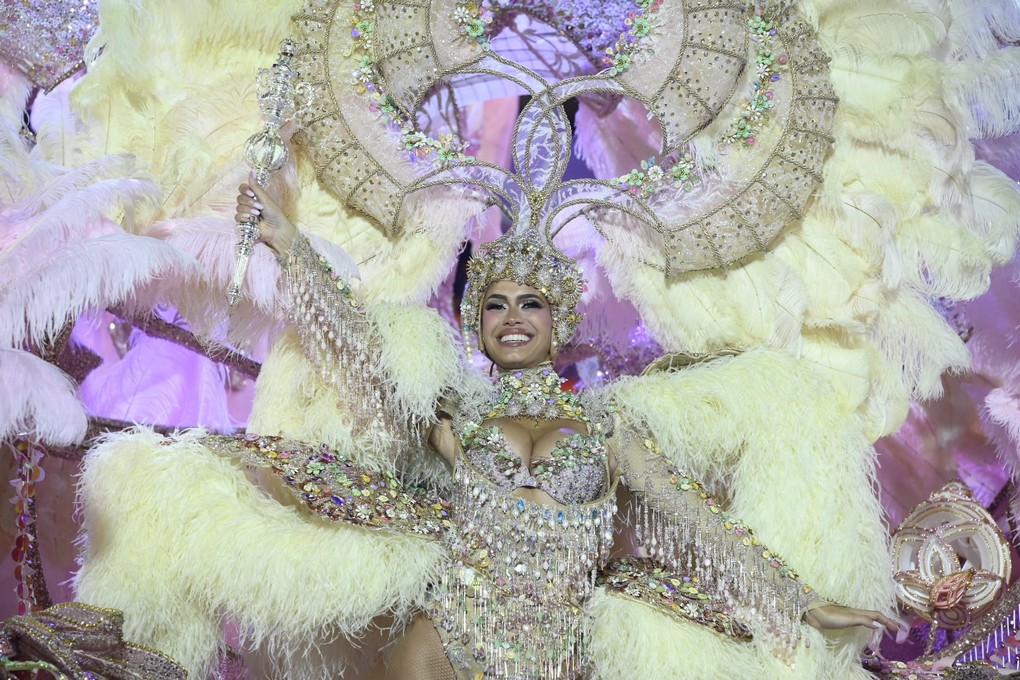
👑 Fantasies weighing hundreds of kilos
And then there’s the Queen. Here, fantasy is the show: structures over four meters tall that weigh hundreds of kilos and roll on wheels. In 2022, one weighed 1,230 kilos and cracked the rotating stage. Back in 1987, the queen carried 300 kilos on her own body, no wheels involved. Everything gets decided in a gala broadcast live on TV, with about seven thousand people at the Fairgrounds.
🎤 The murga: the most Canarian voice of the carnival
The tradition says that the birth of the Canarian murga took place in 1917, when sailors from the gunboat Laya, mostly from Cádiz, hit the streets of Santa Cruz for carnival, singing in the style of their chirigotas (the press had already been talking about murgas since the late 19th century). From there, the murga went on its own: the lyrics take precedence over the music, they sing to well-known songs, kazoos are played, and the costumes are as eye-catching as possible.
The difference from the original is simple: the chirigota from Cádiz is judged at the Gran Teatro Falla; the murga from the Canaries, in a fairground with thousands of people singing along to the chorus. Cádiz is sung literature. The Canaries is crowd-sung lyrics.
Modern contests kicked off in 1961, and now you can find murgas on all the islands, both for adults and kids, with more and more female murgas popping up, hosting their own contests in some towns.

🐟 The Burial of the Sardine: the most fun funeral of the year
The ritual exists all over Spain — its icon is Goya’s oil painting The Burial of the Sardine, created between 1808 and 1812 and now housed at the Royal Academy of Fine Arts of San Fernando — but in the Canaries, it’s taken on a whole new vibe.
It’s a funny funeral procession with tens of thousands of people: a giant sardine several meters long, priests and nuns in costume officiating the service, and an army of “widows” in full mourning, complete with veils and heart-wrenching tears. It ends with the sardine ablaze amidst fireworks. In Las Palmas, in 2026, over 25,000 people bid farewell to a five-meter sardine packed with about 270 kilos of pyrotechnics.

Its load is twofold: it bids farewell to the party and parodies the Catholic funeral, which probably makes it the most Bakhtinian act on the Spanish festive calendar. In Las Palmas, it’s literally the final act, on Las Canteras beach; in Santa Cruz, after the sardine, there’s still the Piñata weekend to enjoy.

🎶 Lots of fun and Daytime Carnival: the party’s in the streets!
If you look at the numbers for Santa Cruz and think about a parade, you’re missing the point. Most of those people aren’t just there to watch: they’re there to dance.
Mogollón is the Canarian word for a massive street party: orchestras playing salsa, merengue, bachata, and Canarian music in squares and avenues, with thousands of people in costumes dancing until dawn. No tickets, no venue, and no chairs needed.
And the Day Carnival is one of the most Canarian formats of the carnival: the same party vibe, but in broad daylight. It kicks off at noon and flows straight into the night; the Piñata Saturday in 2027 promises over eighteen hours of partying. In Santa Cruz, it takes place on the first Sunday of carnival and on Piñata Saturday: in 2027, that’s on February 21st and 27th.
🎺 From Celia Cruz to “Eternal Rome”: the carnival of dizzying numbers
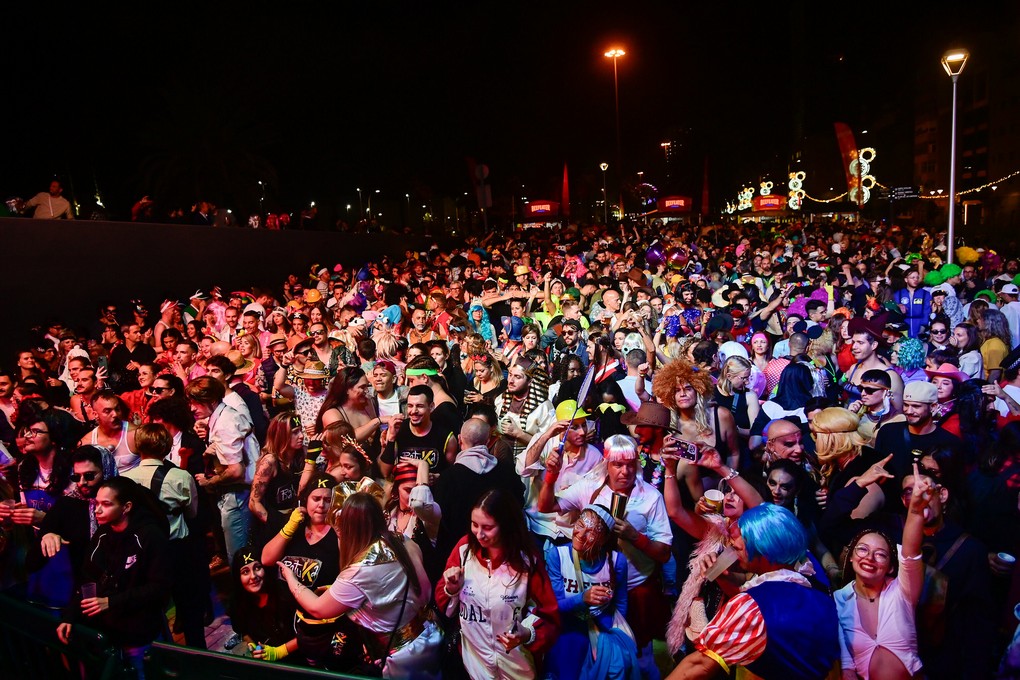
Carnival Tuesday, March 3, 1987. The theme that year was Rome —the first carnival themed around the history of Santa Cruz— and in Plaza de España 240,000 people, counted by a notary, danced with Celia Cruz, La Sonora Matancera, and Billo’s Caracas Boys. That night, it entered the Guinness World Records.
In 2019, with Juan Luis Guerra at the Saturday Day Carnival of Piñata, the Local Police estimated 400,000 people throughout the center.
So, what about today? Over a million people in 2026, and 425,000 on just one Saturday. The Carnival of Santa Cruz de Tenerife is the biggest short-sleeve carnival in Europe, because the Canarian carnivals are the warmest in Europe: 21 °C average high in February, according to AEMET. 🌞
Now head back to the start of this guide, to the official theme for 2027: “Eternal Rome: The Empire of Carnival”. Forty years after that 1987, Santa Cruz is bringing back the theme that got it into the Guinness. And it’s also dedicated to the Rome of the Saturnalia you just learned about. Nothing’s a coincidence. 🏛️
🛏️ Where to crash during Carnival 2027?
February is still high season in the Canary Islands — in February 2026, the islands had the highest hotel occupancy in Spain at 78.4% according to the INE — and during Carnival, it gets even busier: Santa Cruz hit nearly 84%. If you book now, you’ve got options; if you wait until January, you’ll get what’s left.
At Nests Hostels, we’ve got beds on both carnival islands, just a step away from the party!
- Tenerife · Aguere Nest, in La Laguna: right in the UNESCO World Heritage city, just about a ten-minute walk from the tram that takes you to downtown Santa Cruz. Perfect for the Coso on February 23rd and all of the big week festivities.
- Tenerife · Puerto Nest, in Puerto de la Cruz: just a half-hour walk from Plaza del Charco, the heart of the carnival in Puerto de la Cruz.
- Tenerife south: Medano Nest and Ashavana in El Médano, plus Adeje and Duque in Costa Adeje, for the beach carnivals of the south, which dates for 2027 haven’t been announced yet.
- Gran Canaria · Pura Vida, in Guanarteme: just a three-minute walk from Las Canteras, the beach where they burn the sardine.
- Gran Canaria · La Isleta: just a stroll from Las Canteras, in the neighborhood of Manolo García, the local legend who brought the carnival back to the streets in 1976.
- Gran Canaria · Las Palmas Nest, in Vegueta: right in the historic center, super well-connected by bus to Santa Catalina and Las Canteras, with special carnival lines too.
What about Maspalomas? We don’t have a hostel there, but you can hop on a direct bus from Las Palmas using lines 30 and 50 from Global: you can enjoy the Sardina at Las Canteras and be at the start of Maspalomas without even changing islands.
❓ Frequently Asked Questions about Carnival 2027
- When is Carnival 2027?
- And what about Tenerife?
- Which ones are UNESCO World Heritage Sites?
- What’s the biggest one in Europe?
Why does the carnival change dates every year?
Is it true that the carnival comes from the Roman Saturnalia?
Which carnivals are UNESCO World Heritage?
📚 Keep reading
- Nest Pass — one pass to hop between our hostels in Tenerife and Gran Canaria: the carnival of the two islands, all in one trip.
- Tenerife with Nests Hostels — all our hostels on the island, from La Laguna to the south, so you can pick your perfect base.
- The Nests Hostels blog — event guides, festivals, and hidden gems in the Canaries and Ibiza, written straight from our hostels.
Fountains
- Santa Cruz de Tenerife City Council — official Carnival program 2027
- Official Bulletin of the Canary Islands No. 168 — local holidays for 2027
- Santa Cruz de Tenerife City Hall — Carnival 2026 recap
- Canarias7 — dates for the Carnival of Las Palmas de Gran Canaria 2027
- Canarias7 — dates for the Maspalomas Carnival 2027
- Canarias7 — special device from Guaguas Municipales for Carnival
- UNESCO — Representative List of the Intangible Cultural Heritage
- INE — Hotel Tourism Situation, February 2026
- AEMET — climate values of Santa Cruz de Tenerife
- Official Bulletin from February 5, 1937 — suspension of the carnival festivities
- LIESA — Rio Carnival 2027 parade schedule
- Cologne City — carnival season dates
Last updated: September 16, 2026. The schedules for Santa Cruz and the programs for Puerto de la Cruz, El Médano, Los Cristianos, and Maspalomas will be published between October 2026 and February 2027: we’ll update this guide as soon as they come out.