On Wednesday 12 August 2026, the Moon’s shadow sweeps across the Atlantic and lands on Spain. Depending on which of our islands you’re standing on that evening, you’ll either watch the Sun go out completely at sunset — or watch about 70% of it disappear.
Here’s the honest version, because a lot of articles are being vague about this: Ibiza is inside the path of totality. Tenerife and Gran Canaria and most of europen cities are not. Both are absolutely worth watching. Neither is worth watching without proper eye protection.
- Where to watch it in Europe
- Ibiza: inside the path of totality
- Tenerife: 70% at sunset
- Gran Canaria: go high
- The next eclipses in Spain
- FAQ
This is the first total solar eclipse over mainland Spain since 30 August 1905. After the follow-ups in 2027 and 2028, Spain doesn’t get another one until 2053. So, yeah — next Wednesday matters.
The short version: what each island gets
| Island | What you’ll see | Maximum at | Sun height |
|---|---|---|---|
| Ibiza | Total eclipse — roughly 45 seconds to 1 min 20 sec, depending where you stand | ~20:33 CEST | ~3° above the sea |
| Tenerife | Partial — about 70% of the Sun covered | ~19:53 WEST | ~11° |
| Gran Canaria | Partial — about 70% of the Sun covered | ~19:53 WEST | ~10° |
One thing every island shares: the Sun will be very low. This is a sunset eclipse. A clear view west — over open sea if possible — matters more than anything else you’ll plan.
What actually happens during a solar eclipse?
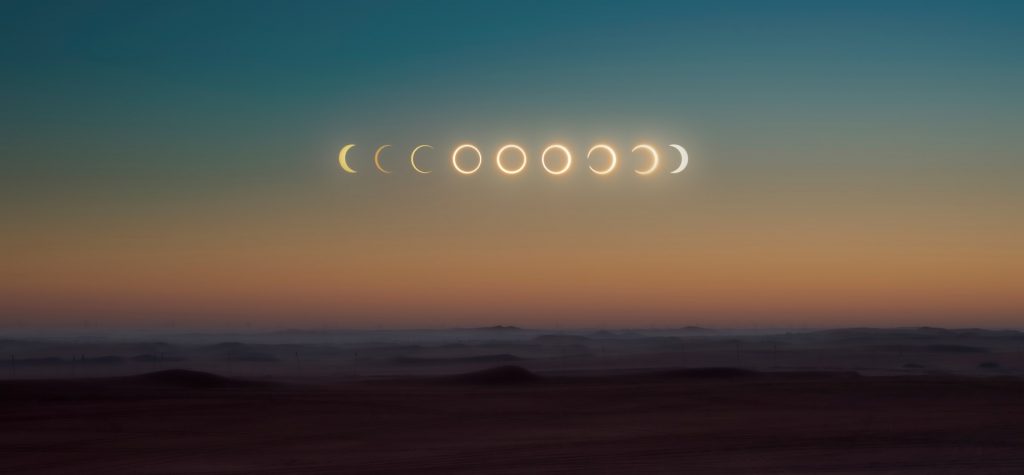
A solar eclipse happens when the Moon passes directly between Earth and the Sun and blocks its light. Because the Moon’s orbit is tilted about 5°, that lines up perfectly only a couple of times a year — and only along a narrow strip of the planet at a time.
The four types, quickly
- Total — the Moon covers the Sun completely. The sky goes dark and the corona appears. Only visible inside the path of totality.
- Partial — a bite is taken out of the Sun. Visible across a much wider area on either side of that path.
- Annular — the Moon is further from Earth, so it’s too small to cover the Sun and leaves a bright “ring of fire”.
- Hybrid — rare, shifts between total and annular along its path.
Why “70%” is nothing like “100%”
This is the bit worth understanding before you decide where to go. Obscuration is the share of the Sun’s area the Moon covers — that’s the percentage everyone quotes. Magnitude is the share of its diameter.
The gap between 99% and 100% is not 1% of the experience — it’s the whole thing. Even with 99% of the Sun covered, the remaining sliver is still blindingly bright, the sky stays light, and you cannot look without protection. Totality is a different event entirely. That’s why Ibiza is in a different category from Tenerife and Gran Canaria next Wednesday.
What you see when it goes total
The corona — the Sun’s pearly outer atmosphere — appears around a black disc. Just before and after, sunlight streams through valleys on the Moon’s edge as Baily’s beads, then collapses into a single diamond ring. The temperature drops noticeably. Bright stars and planets come out. Cicadas stop. And because the Sun is so low over Ibiza, you get a 360° sunset glow all the way around the horizon.
Where to see the solar eclipse in Europe
The path of totality starts over the Arctic, crosses eastern Greenland and western Iceland, runs down the North Atlantic, then enters Spain through Galicia and cuts diagonally across the north of the peninsula before exiting over the Balearic Islands — the last land on Earth to see it before the shadow leaves at sunset.
Greatest eclipse is at 17:47 UTC near Iceland, with a maximum of 2 minutes 18 seconds of totality. The shadow’s band is up to 294 km wide.
Inside the path: Iceland and northern Spain
In mainland Spain, totality reaches A Coruña, Oviedo, Gijón, Santander, Bilbao, León, Burgos, Zaragoza and Valencia, among others. Oviedo sits near the centreline with roughly 1 min 49 sec — the longest on the peninsula. Bilbao, right on the northern edge, gets only about 31 seconds.
Madrid, Barcelona and Seville are outside the path. They get a very deep partial and nothing more.
Outside the path: how much of the Sun disappears where you live
| City | Sun covered |
|---|---|
| Madrid | ~99% |
| Barcelona | ~99% |
| Lisbon | ~95% |
| Dublin | ~94% |
| Paris | ~92% |
| Milan | ~92% |
| London | ~91% |
| Brussels | ~90% |
| Berlin | ~85% |
| Vienna | ~85% |
| Tenerife / Gran Canaria | ~70% |
How to watch it without wrecking your eyes
Read this bit properly. You need glasses certified to ISO 12312-2 — look for the CE mark and the reference EN ISO 12312-2:2015 printed on the frame. Wear them for every phase of the eclipse.
The single exception is during totality itself — that one minute in Ibiza when the Sun is fully covered. Glasses come off, then straight back on the instant the diamond ring reappears. In Tenerife and Gran Canaria there is no safe naked-eye moment at all.
What does not work
- Sunglasses — including very dark ones, including two pairs stacked
- Smoked glass, CDs, exposed camera film, old X-rays
- Looking through your phone screen, or any “filter” app
- Squinting and looking quickly. Retinal burns are painless and may only show up hours later.
Spain’s consumer organisation OCU has been warning specifically about counterfeit glasses sold online ahead of this eclipse. Buy from a source you trust, and check the printed certification.
Where to get certified glasses in the Canaries — free
Spain’s Ministry of Science and Grupo Social ONCE are handing out two million certified pairs nationwide under the campaign “Una vista única. Cuídala.” In the islands that means:
- Tenerife — Museo de la Ciencia y el Cosmos, La Laguna (running since 27 July, while stocks last)
- Gran Canaria — Museo Elder, Las Palmas (from 4 August, while stocks last)
- All islands — ONCE vendors, since 3 August
They will run out. Sort this early in the week, not on the day.
Cameras and phones
Any lens — phone, camera, binoculars, telescope — needs a proper solar filter fitted over the front. Never point an unfiltered lens at the Sun and never look through optics while wearing eclipse glasses; concentrated light burns straight through them.
Real talk on photos: totality in Ibiza lasts about a minute. Phone footage of it will look like a small white dot. Watch it with your eyes. Shoot the crowd, the light, the horizon — that’s the stuff that actually comes out.
Ibiza: the only one of our islands inside the path of totality
The whole of Ibiza sits inside the totality band — but near its southern edge, which is why totality is short here. The trade-off is a good one: the Sun sits about 3° above the horizon at maximum, slightly higher than in Mallorca. You’ll be watching the corona hang like a silver ring just above the Mediterranean.
Ibiza eclipse times
| Partial eclipse begins | ~19:39 CEST |
| Totality begins | ~20:32:30 |
| Maximum | ~20:33 |
| Totality ends | ~20:33:40 |
| Sunset | ~20:50 — the Sun sets still partially eclipsed |
The eight official viewing zones in Ibiza and Formentera
The Balearic Government has set up 26 official observation zones across the islands, chosen for sightlines, access, parking and emergency cover. Six are in Ibiza, two in Formentera — and they come with published totality durations:
| Official zone | Municipality | Totality |
|---|---|---|
| Cala Gració | Sant Antoni de Portmany | ~1 min 11 sec |
| Sant Antoni coast | Sant Antoni de Portmany | ~1 min 10 sec |
| Sa Pedrera / Port des Torrent | Sant Josep | ~1 min 08 sec |
| Cala Comte | Sant Josep | ~1 min 05 sec |
| Cala Llentia | Sant Josep | ~1 min 04 sec |
| Cala Molí | Sant Josep | ~1 min 04 sec |
| S’Estany des Peix | Formentera | ~46 sec |
| Es Arenals | Formentera | ~45 sec |
Where to actually stand
Everything on the west coast faces the right way. The east coast does not — if you’re in Santa Eulària or Es Canar, you need to cross the island.
- Cala Gració — official zone, the longest totality of the six, and a 20–25 minute walk north along the coast from Sant Antoni’s port. If you’re staying in San Antonio, this is the obvious one.
- Sant Antoni bay / the sunset strip — official zone, easiest logistics of anywhere on the island, bars and buses right there. Also the busiest.
- Cala Comte — textbook open-sea horizon and the classic choice. Expect the parking to be gone hours early.
- Cala d’Hort — Es Vedrà in the frame, the most photogenic spot in Ibiza. Not an official zone, small car park, everyone knows about it.
- On a boat — no hills, no buildings, no crowd. If you can get on the water, do.
Traffic control across Ibiza steps up from 10:00 on eclipse day. Do not plan to drive over at 20:00 — the west-coast roads and car parks fill long before sunset. Get there in the afternoon, bring water and something warm, and treat it as a beach evening that happens to have an eclipse in it.
You’ll be sat on a beach for hours either way, so it’s worth picking well — we ranked the 10 best beaches in Ibiza by which coast they’re on, west for the sunsets and east for the calm water. Cala Comte, Cala Gració and Cala d’Hort all turn up on both lists.
Staying with us in Ibiza? Cisne by Nest puts you in Sant Antoni, walking distance from two of the six official viewing zones. Flamingo by Nest is over in Es Canar, so plan the trip west before the buses get silly.
Tenerife: a 70% eclipse hanging over the Atlantic
Tenerife sits well south of the path, so there’s no totality here. What you get instead is roughly 70% of the Sun covered while it’s low over the ocean — a crescent Sun sinking into the Atlantic. Different event, still a good one.
| Partial eclipse begins | ~18:57 WEST |
| Maximum (~70% covered) | ~19:53, Sun ~11° up, west-north-west |
| Ends | ~20:44 — essentially at sunset |
The cloud problem, and how to beat it
August in the north of the island means panza de burro — the low grey cloud layer the trade winds pin against the northern slopes. It sits below roughly 1,300–1,500 m. Two ways out: go up above it, or go to the west and south coasts, which usually stay clear.
Best spots by where you’re based
- From Costa Adeje or Las Américas — head up the west coast to Los Gigantes / Puerto de Santiago. Mirador de Los Guíos sits right by the beach with the cliffs and open Atlantic straight ahead. Best-oriented easy option in the southwest.
- From El Médano — walk to Playa de la Tejita under Montaña Roja. Wide, open, low-key, and you can watch it with your feet in the sand.
- From Puerto de la Cruz — Playa Jardín for the westerly view, but check the sky first; the north coast is where the cloud risk lives.
- From Santa Cruz — Playa de Las Teresitas and the port area give you open water. Avoid the tall-building streets downtown; an 11° Sun disappears behind anything.
- Garachico — clean western horizon, natural pools, noticeably fewer people than the resorts.
Two warnings. Punta de Teno is a beautiful sunset spot but daytime car access is closed and the last return bus from Buenavista del Norte leaves too early to get you through maximum — check the current TITSA timetable before you count on it. And Teide National Park is not the guaranteed win it sounds like: the caldera walls and the cone itself can block a Sun this low, and the summit trail needs a free permit booked in advance through the Cabildo.
Gran Canaria: same 70%, and altitude is the trick
Gran Canaria gets almost exactly what Tenerife does — around 70% of the Sun covered in Las Palmas, a little under that down in Maspalomas — at the same time, with the Sun about 10° up.
| Partial eclipse begins | ~18:58 WEST |
| Maximum (~70% covered) | ~19:53, Sun ~10° up, west-north-west |
| Ends | ~20:45 — at sunset |
Las Palmas and Las Canteras face the wrong way for a west-north-west Sun and catch the same low cloud as northern Tenerife. Going up into the middle of the island solves both problems at once.
- Pico de las Nieves (1,949 m) — the surest bet. You end up above the cloud layer watching an eclipse over a sea of cloud. Cold and windy at the top, so bring a layer.
- Mirador Degollada de Becerra — proper car park, west-north-west orientation, Roque Nublo in the frame without blocking the Sun.
- Puerto de las Nieves, Agaete — west coast, usually escapes the northern cloud, and you’re at sea level with a clean horizon.
- Mirador de Bandama — closest elevated option to Las Palmas if you don’t want the full mountain drive.
Bonus: on 12 August the Museo Elder is running a staffed public observation point on every Canary island, roughly 18:30–21:30, with free certified glasses. The museum itself closes that day because the whole team is out in the field. Check their channels for the confirmed Gran Canaria location.
Doing both Canary islands? The Nest Pass gives you seven nights across our Tenerife and Gran Canaria hostels on one booking — handy if you want to chase the clearest forecast between islands rather than commit to one.
Your eclipse day plan
- This week — get certified glasses. Scout your spot in daylight and check what’s actually on the western horizon.
- Two days before — check the forecast. If your coast looks cloudy, switch sides of the island or gain altitude. Have the plan B picked already.
- Eclipse afternoon — be in position early. Ibiza west coast: by 18:00. Canaries: by 18:30, well before first contact.
- Bring — water, a warm layer, closed shoes for rocky ground, a light for the walk back, and a fully charged phone.
- Afterwards — stay out. It’s a new Moon and the Perseid meteor shower peaks the same night, so the sky is as dark as it gets all year.
Or skip the planning and come with us
Both our Ibiza hostels walk out together on 12 August. The Flamingo group leaves Es Canar at 15:00, everyone leaves Cisne by Nest at 18:00 — on foot, so no car, no checkpoint and no parking hunt — and we’re in position on the west coast long before first contact. Totality at 20:32, then a fire show under the Perseids. Free for anyone staying with us.
Missed it? Spain gets two more
Spain is in the middle of a rare run of three eclipses, and the Canaries do better in the next one than in this one.
- 2 August 2027 — total. The path crosses the Strait of Gibraltar and far southern Spain in the morning; Ceuta gets up to 4 min 48 sec, one of the longest totalities of the century. The Canaries get a deeper partial than in 2026.
- 26 January 2028 — annular. The “ring of fire” crosses the peninsula from southwest to northeast just before sunset. The Canaries see a partial.
- 28 August 2026 — partial lunar eclipse, visible from the whole of Spain including the Canaries. Two weeks after the big one, and you don’t need any eye protection for a lunar eclipse.
After 2028, the next total solar eclipse over Spain is in 2053.
Solar eclipse 2026 FAQ: your questions answered
Can you see the total solar eclipse from Tenerife or Gran Canaria?
Is Ibiza in the path of totality for the 2026 eclipse?
What time is the solar eclipse on 12 August 2026?
Do I need special glasses to watch the eclipse?
Where can I get free eclipse glasses in the Canary Islands?
Where are the official viewing points in Ibiza?
When is the next solar eclipse visible from Spain?
Wherever you watch it from
Certified glasses on. A clear view west. Get there early. That’s the whole formula.
We’ve got beds across Tenerife, Gran Canaria and Ibiza, and 12 August is a Wednesday in the busiest week of the year — so if you’re still deciding where to watch from, decide quickly.
Keep reading
- Ibiza events in August 2026 — everything else on the island that month: the Festes de la Terra fireworks, the Sant Bartomeu fiestas and every club residency running.
- The 10 best beaches in Ibiza — west coast for the sunsets, east coast for the calm water, sorted by which side of the island you’re waking up on.
Eclipse times and percentages are based on data from NASA and Spain’s Instituto Geográfico Nacional. Because the Sun sits so low at maximum, exact circumstances change over short distances — check your precise spot on the IGN eclipse viewer at eclipses.ign.es. Official viewing zone details are published by the Govern de les Illes Balears.